

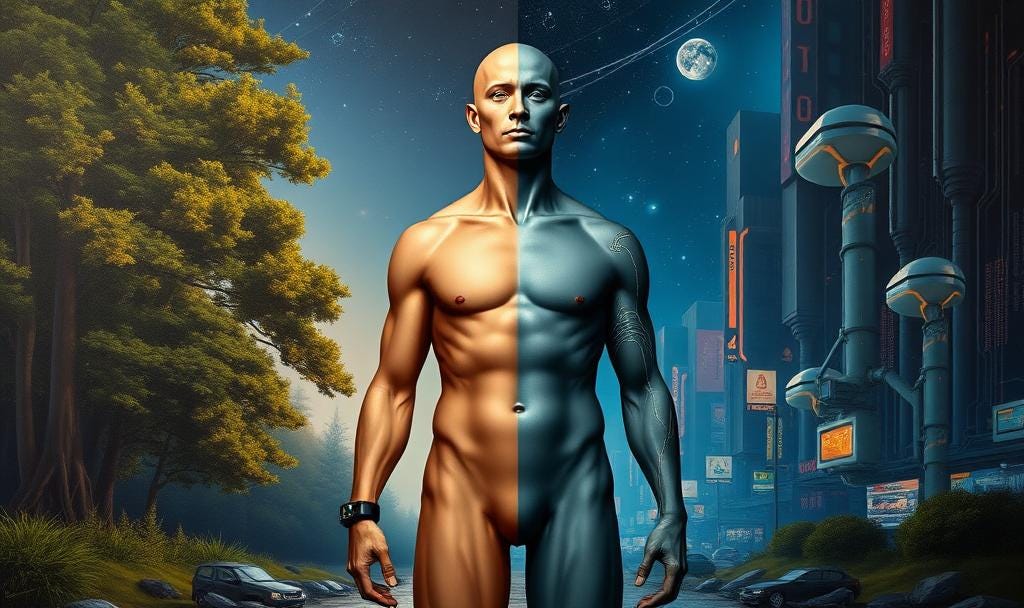
You don’t need a brain chip to be living in the future. You don’t need a robotic arm or glowing eyes to qualify as part-machine. If you own a smartphone, shop in a store with cameras, drive a car with adaptive safety features, or have medical records stored in a digital database, you’re already inside the transhumanist experiment—whether you asked to join or not. And the most surprising part? You probably like it.
I know, I know you’re probably remarking (and resisting) to this first paragraph because you don’t want to think for a moment that you’ve been inveigled slowly and insidiously to accept transhumanism, but you have, awhile back.
Pleases read on, there’s hope.
When people talk about transhumanism, it’s often with a kind of shiver—half fear, half fascination. We picture some gleaming, unnerving future: microchips fused to our brains, AI coursing through our veins, titanium frames replacing our bones. The tone is always urgent, as though transhumanism is some cybernetic half-human monster lurking just beyond the horizon.
But the truth is, that horizon came a long time ago.
Philosophically, transhumanism is the belief that humans should use technology to improve, enhance, or even replace the limits of the body and mind. In its boldest form, it’s about radical life extension, (supposed) genetic redesign, AI-human symbiosis—technologies that fundamentally change what a human is. But there’s also a quieter, more pervasive strain—a soft transhumanism—that didn’t announce itself with chrome limbs or brain implants. Instead, it seeped into everyday life awhile ago, through medicine, cosmetics, consumer devices, and convenience tech, changing how we see ourselves without us even noticing.
Look closely, and and you’ll see it not just in cybernetic experiments, but in breast augmentations, teeth veneers, fingernail extensions, tattoos, and elective cosmetic surgeries. Even buzzwords that are now all too familiar—“biohacking,” “gene-editing,” “morphological freedom,” “life extension”—have been soldered into our vocabulary. These terms aren’t about saving lives; they carry the same underlying premise: that what we were born with is insufficient and must be upgraded to match an external ideal. For decades, we’ve been trained—by advertisers, industries, and pop culture—to distrust our natural form and to believe power, beauty, and worth can be bought, manipulated, even enhanced. Whether the tool is a titanium joint, a neural implant, or an AI program for your business, the formula is the same: identify the “flaw,” present the fix, sell the upgrade.
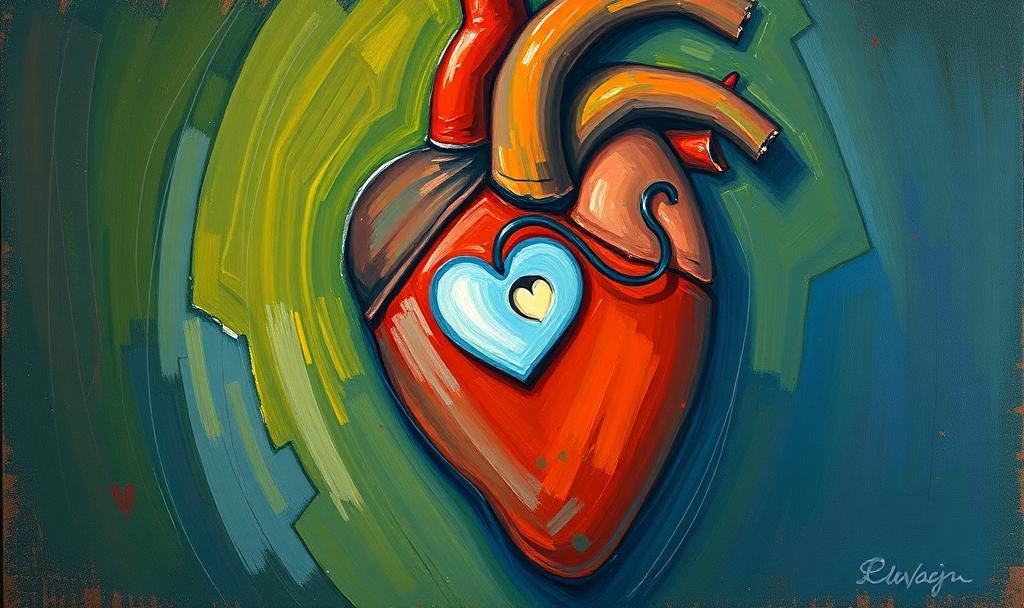
Take the pacemaker. In 1958, a Swedish man named Arne Larsson became the first person to receive a fully implantable one. The headlines called it a miracle—and in many ways, it was. Larsson lived decades beyond expectation (though I’d say from a naturopath’s standpoint seems as though the scientist had little to no understanding of the human healing capacity), outlasting even the scientists who built the device. But it also marked a subtle turning point in human history: for the first time, a machine didn’t just assist the body—it replaced a biological function outright. From then on, the heart’s natural rhythm wasn’t the sole authority. Technology would now take the lead.
Since then, the list has grown almost without notice: mechanical hips and knees, cochlear implants, artificial heart valves, insulin pumps, retinal implants, dialysis machines. They’re miracles to those who need them, restoring independence, mobility, and sometimes life itself. But they also carry a quieter, more enduring message—one we rarely examine: you and your body cannot be trusted to care for itself. Prevention is out of reach, decline is inevitable, and eventually you will need technological intervention. Slowly, we stop thinking of the body as a resilient, self-healing organism and start seeing it as a fragile, error-prone machine that must be monitored, upgraded, and patched. We forget that human biology is not static—it’s an evolving, adaptive system fine-tuned over vast time. What it needs is tending, nurturing, and trust in its subtle capacities—not passive resignation to the narrative modern science too often promotes: pathological inevitability.
And this message doesn’t stop with the body. In daily life, we’ve willingly ceded tasks once considered basic to being human. We no longer remember phone numbers—they live in our devices. We don’t study the stars or landmarks to navigate; we trust GPS. We rarely calculate in our heads, write letters by hand, or track the seasons by observing the world around us. Little by little, we’ve traded self-reliance—and the imperfections that come with it—for convenience and automation. This is soft transhumanism at work: every small surrender building into a cultural shift where dependence on technology feels not just normal, but essential to survival and growth.
This acceptance didn’t start recently. Growing up in the early ’90s, many of us were steeped in comic book and sci-fi worlds where being “more than human” wasn’t just possible—it was the ultimate goal. Marvel heroes with adamantium skeletons, indestructible shields, cybernetic limbs, and enhanced senses filled our imaginations. The idea of augmenting ourselves wasn’t frightening; it was thrilling. Who better to catch criminals than a cybernetic enforcer like RoboCop? Who wouldn’t want Wolverine’s healing factor, Neo’s martial arts upgrades, or Iron Man’s armor?
Back then, the dream of upgrading the human body wasn’t seen as surrendering to technology—it was about becoming something greater, faster, stronger. A hero the community, even the world, could depend on. The enticing possibility of “being better than human” was everywhere, woven into our childhood heroes and quietly shaping what we thought progress should look like. This is why the “future” of transhumanism isn’t the right conversation to have. The more urgent question is: have we already accepted it—without realizing, and maybe even wanting it to continue? And if so, what is that quiet surrender doing to the way we understand ourselves—not just individually, but as humanity?
Yet here’s the irony: many of the voices warning about the dangers of transhumanism—outraged by the idea of wearable devices or Elon Musk’s brain-chip technology—are the very same people already living in a quietly augmented world. They carry smartphones that track their movements and answer their questions, drive cars with adaptive cruise control and lane assistance that scold them to keep their eyes on the road, shop in stores whose cameras scan their faces, wear rings and watches to measure their sleep, and visit clinics whose databases hold their most private medical details. They even accept technologies marketed to shield them from the “genetic dangers” of EMFs. Without hesitation, they move through a landscape where technology doesn’t just assist them—it monitors, “protects”, records, and predicts them. The real outrage isn’t that technology has entered our lives; it’s that we prefer to deny just how completely it already has.
See, technology itself is not the villain. It can be a brilliant partner—an extension of our ingenuity, a life-saving intervention, a bridge between what is and what could be. But a partner is not the same as a master or savior. The danger comes when we stop seeing technology as an occasional ally and start treating it as the permanent solution to our poor choices—or worse, as proof that the human body is defective by design. When we default to technology without first trusting our bodies’ innate intelligence—and supporting it with beneficial choices, adaptive challenges, and lived experiences that shape us—we rewrite the story of what it means to be human. And that story matters. It sets our expectations of health, our tolerance for discomfort, our curiosity about the unknown, our willingness to let the body attempt repair before we rush to override it. It determines whether we see ourselves as living beings capable of adaptation—or as flawed machines that require constant intervention.
We need to remember: the human body is not a relic waiting to be replaced. It is an active, dynamic system, capable of profound healing and adjustment when given the right conditions. Wounds close. Bones knit. Hearts find rhythm. Organs relearn. Even the mind—arguably our most mysterious organ—has astonishing capacity for growth and rewiring. These abilities are not science fiction; they are happening inside you right now, without a single line of code. Yet sadly, many people believe—especially when told by doctors—that when a knee wears down or a heart skips its rhythm, surgical enhancement is inevitable. That is far from the truth. What needs replacing is not the body but the mindset around it. We must relearn how to trust its intelligence, and we must recognize that the consequences we face often come not from “defective design,” but from the ways we neglect, mistreat, or misunderstand our own biology.

We are not fragile machines waiting for parts. We are the superheroes of miraculous healing—given enough support and time. We don’t need technology to make us amazing, physically or mentally—we already are. But that doesn’t mean we reject technology. It means we guard the line between assistance and dependence. We use interventions when they are truly necessary, work hard to maintain the balance in bodies and minds and not simply choose to wait for a quick fix because they are available. We preserve space for the body’s own wisdom to work, instead of immediately assuming it has failed. We keep our skills sharp, our senses awake, our trust in ourselves intact. Because if the decades of steady acceptance of soft transhumanism has taught us anything, it’s that you don’t need a robot arm to lose something human—you can give it away bit by bit, without ever feeling the loss. But the opposite is also true: we can choose to reclaim it, bit by bit, every time we trust the strength of our own biology, our own existence, every time we refuse to outsource what we’re still capable of doing ourselves. And when we remember that, we don’t just protect our humanity—we expand it.
We discover that the resilience, courage, and raw vitality we admired in our childhood heroes was never locked inside adamantium skeletons or cybernetic upgrades. It was always in us, waiting to be trusted.
Neuralink is a pipe dream that can't even fix the physical issues of rejection of the implants (animal trials were a huge failure). It also ignores how the brain works... The way you process and remember information is in your "code" which is different than everyone else's.
https://posthumousstyle.substack.com/p/neuralink-does-not-read-minds-and
Why would these "geniuses" overlook brain basics like that?
Because they're essentially crazy idiots.
https://posthumousstyle.substack.com/p/are-the-tech-bros-insane
https://robc137.substack.com/p/left-brain-vs-whole-brain-in-battlestar
Add genetic engineering to this too. It's been a long time since the "success" of CRISPR cloning Dolly and they still can't use it for anything useful. Supposedly they made animals glow in the dark but they fail to mention that the injection they used has glow in the dark chemicals already in it! Genetics schmenetics.
They can't even engineer a deadly virus, instead having to hype up the "flu" and then claiming it got deadly with the delta variant which was a cover for the crap vaccines!
This why I trust and believe , that we are perfectly formed and God Created. And the more interventions from the medical industry, the further we move away from our trueness